Airborne Collision Avoidance System Market Future Outlook and 5.62% CAGR Trends
Technological innovation is
reshaping the global Airborne Collision Avoidance System Industry, with
manufacturers developing sophisticated surveillance, tracking, and alerting
solutions that enhance pilot decision-making and operational safety. Advancements
in avionics, sensor fusion, and air traffic management systems are supporting
the widespread adoption of next-generation collision avoidance platforms.
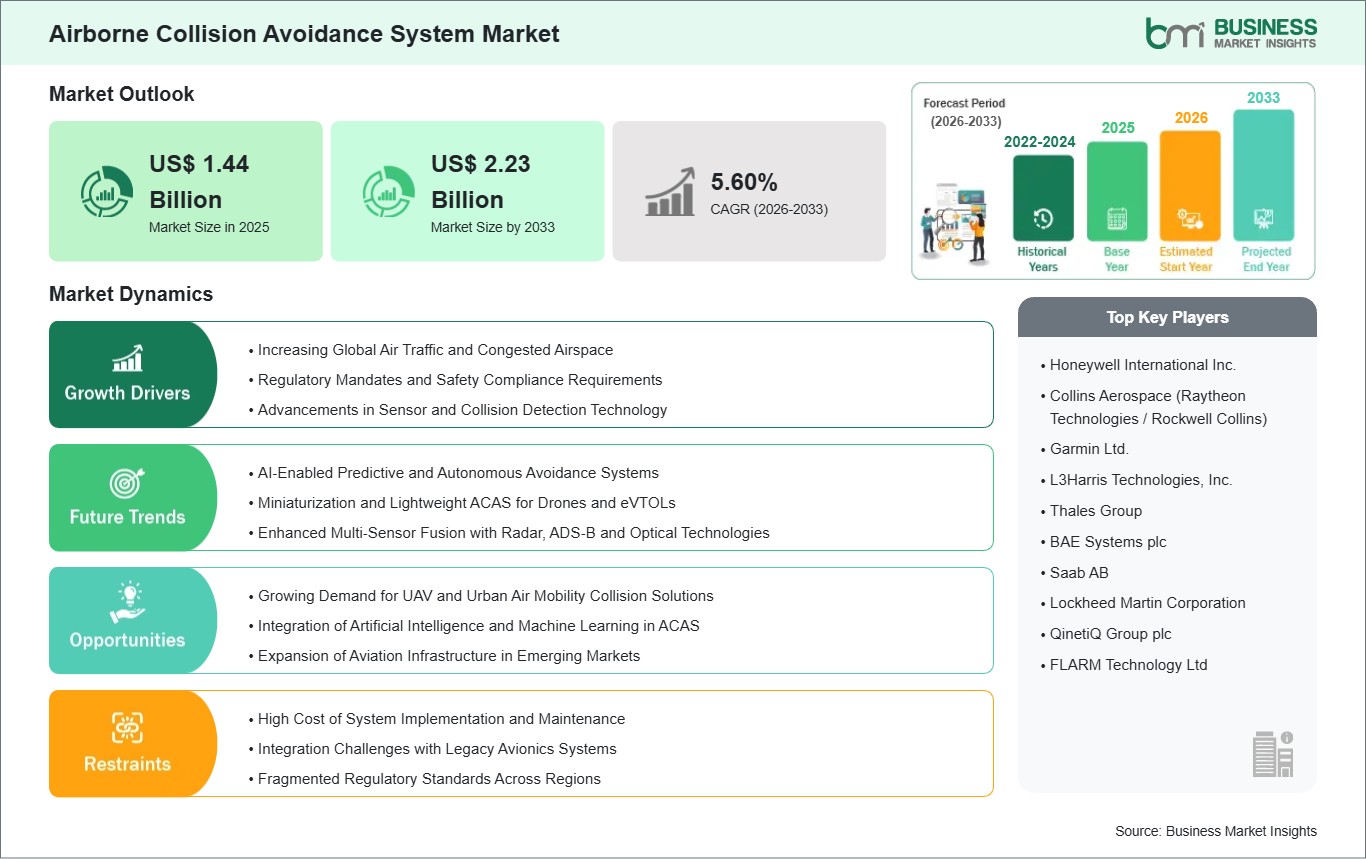
According to Business Market
Insights, the global Airborne
Collision Avoidance System Market was valued at US$ 1.44 billion in
2025 and is anticipated to reach US$ 2.23 billion by 2033. The market is
projected to grow at a CAGR of 5.62% during the forecast period from 2026 to
2033.
As advanced glass cockpits become
standard across regional and international fleets, modern ACAS architectures
act as a crucial line of safety defense against mid-air collisions. By actively
interrogating the transponders of nearby aircraft via specialized radio
frequencies, these systems map regional airspace in real time, calculate
potential flight path intersections, and issue split-second automated
Resolution Advisories (RAs) to pilots. Capital investment within the industry
is heavily focusing on multi-sensor data fusion, blending radar, ADS-B
(Automatic Dependent Surveillance-Broadcast), and cooperative transponder feeds
into a single unified safety stream.
What Are Airborne Collision
Avoidance Systems?
Airborne Collision Avoidance
Systems (ACAS) are specialized aircraft avionics arrays designed to operate
independently of ground-based air traffic control (ATC) infrastructure. These
systems function by continuously broadcasting interrogation signals and
listening for responses from transponders equipped on other nearby aircraft. By
calculating the time delay, signal frequency shift, and directional vector of
the reply, the onboard ACAS computer establishes a real-time relative position
matrix of surrounding air traffic.
If the system detects an impending
conflict where the horizontal and vertical separation boundaries are
compromised, it acts as a tiered safety shield. It first issues a visual and
auditory Traffic Advisory (TA) to alert the flight crew of nearby traffic. If
the collision risk escalates, the system elevates the warning to a Resolution
Advisory (RA), providing explicit vertical maneuver instructions (such as
"Climb" or "Descend") natively on the primary flight
display to guide the pilots along a safe evasive path.
Download Sample Report: https://www.businessmarketinsights.com/sample/BMIPUB00033251
Market Drivers
A primary driver accelerating the
global ACAS Industry is the Transition to Next-Generation ACAS X
Architecture. The global aviation industry is actively transitioning from
legacy TCAS II architectures to the next-generation ACAS X framework. While
traditional systems rely on rigid, pre-programmed, rule-based lookup tables
that often trigger unnecessary warnings, ACAS X utilizes dynamic, probabilistic
models and advanced software-defined algorithms. This optimization improves
collision avoidance efficiency by approximately 30%, drastically minimizing
"nuisance" alerts in highly congested terminal radar service areas
and allowing closer, safer aircraft separation profiles near major global
airport hubs.
The Proliferation of
Autonomous Systems and Advanced Air Mobility (AAM) serves as another
core driver. The massive expansion of commercial drone applications across
logistics, agricultural monitoring, and critical infrastructure inspection is
structurally altering market demand. UAV platforms require robust "detect
and avoid" capabilities to safely navigate non-segregated commercial
airspace. Additionally, the emergence of electric vertical takeoff and landing
(eVTOL) systems designed for urban air mobility has created an entirely new
pipeline for certified, low-power, lightweight collision avoidance modules
tailored for dense, low-altitude city environments.
Additionally, Regulatory
Compliance and Fleet Modernization Mandates remain primary market
catalysts. Stricter safety mandates issued by international regulatory
authorities, including the Federal Aviation Administration (FAA) in the United
States and the European Union Aviation Safety Agency (EASA) in Europe, require
commercial passenger liners, cargo transports, and high-capacity regional
aircraft to be equipped with interoperable transponder networks. New
operational guidelines require continuous tracking updates, forcing extensive
hardware retrofits and aftermarket upgrades across aging commercial fleets.
Market Segmentation
By System Type
- Traffic
Collision Avoidance Systems (TCAS) (Maintained a dominant position with a
38.4% market share in 2025, sustained by long-standing global mandates for
commercial passenger aircraft transport)
- Airborne
Collision Avoidance Systems (ACAS) (Represents the fastest-accelerating
segment with a projected 9.1% CAGR, propelled by software-defined ACAS X
upgrades and military transport installations)
- FLARM
& Portable Systems (PCAS) (Combines for over 25% of total market
revenue, providing highly cost-effective, ultra-lightweight safety layers
tailored for general aviation, gliders, and private light-sport aircraft
operators)
By Platform
- Commercial
Aircraft (Commands the largest overall presence at 42.6% market share,
driven by the persistent recovery and expansion of international tourism
and commercial fleet expansions)
- Military
Aircraft (Secures a major share of 27.3%, backed by tactical data-link
integration, defense modernization programs, and the deployment of
collision avoidance layers within high-performance fighters and strategic
airlifters)
- Unmanned
Aerial Vehicles (UAVs) (Tracks the highest forward growth index at 12.4%
CAGR, as regulatory frameworks require commercial drones to possess robust
airspace awareness capabilities)
By Component Architecture
- Transponders
(Mode S/ADS-B) (Controls 39.8% of the component market share, operating as
the essential transceiver backbone required for active signal broadcasting
and vehicle-to-vehicle coordinate exchange)
- High-Performance
Processors (Expanding at a 7.8% CAGR due to the intensive computing
demands required to execute complex machine-learning vision algorithms and
real-time flight trajectory analytics)
- Display
Units & Cockpit Interfaces (Comprising 19.6% of the sector, this
segment focuses heavily on integrating visual resolution advisory vectors
natively into primary flight displays)
Regional Insights
- North
America holds the premier position globally with a commanding 35%
market share. This leadership is anchored by the immense operational scale
of domestic airlines, high general aviation penetration, and continuous
NextGen air traffic management system rollouts by the FAA.
- Europe captures
28% of global revenues, supported by strict compliance structures under
EASA, a highly unified airspace architecture, and anchor Tier-1 aerospace
supply chains across Germany, France, and the United Kingdom.
- Asia-Pacific is
positioned as the fastest-accelerating geographic theater, expanding at an
impressive localized sub-CAGR of 9.2%. Rapid commercial fleet growth in
China and India, coupled with expanding domestic defense allocations,
underpins this regional surge.
- Rest
of the World accounts for the remaining 12% market share,
displaying progressive growth patterns driven by sovereign smart-airport
overhauls and massive long-haul fleet expansions across major Middle
Eastern transportation hubs.
Top Players in the Industry
The competitive ecosystem of the
ACAS sector is characterized by intense consolidation among established, tier-1
defense and aerospace electronics conglomerates. Key market strategies involve
creating tightly coupled hardware-software ecosystems capable of sensor fusion.
- Honeywell
International Inc.
- Collins
Aerospace (RTX Corporation)
- L3Harris
Technologies, Inc.
- Garmin
Ltd.
- BAE
Systems plc
- Saab
AB
- Thales
Group
- Lockheed
Martin Corporation
Strategic Industry Challenges
Despite high enterprise demand,
widespread market deployment is restricted by steep upfront capital intensity.
Upgrading legacy avionics to next-generation ACAS X systems introduces
significant integration complexities, with operators reporting an average 25%
increase in installation overhead costs. Furthermore, routine lifecycle
maintenance, multi-modal calibrations, and mandatory regulatory testing account
for approximately 20% of total system lifecycle expenses, creating an adoption
barrier for small regional carriers and general aviation pilots.
Future Market Outlook
The long-term trajectory for the
Airborne Collision Avoidance System Market remains highly resilient as civil
and commercial airspace grows increasingly dense. The ongoing intersection of
AI software analytics, miniaturized microelectronics, and multi-sensor data
arrays ensures that collision avoidance technologies will remain an absolute
baseline requirement for global aviation safety operations through the coming
decades.
Frequently Asked Questions
(FAQs)
What is the projected size of
the global ACAS market by 2034?
The market is projected to reach
an estimated valuation of USD 5.1 Billion by 2034, growing from an established
base of USD 2.8 Billion in 2025.
What makes ACAS X superior to
legacy TCAS II systems?
ACAS X replaces rigid lookup
tables with probabilistic models and software-defined algorithms, reducing
unnecessary "nuisance alerts" by 30% and improving overall spatial
safety in congested flight corridors.
Which regional market is
expanding at the fastest rate?
The Asia-Pacific region is the
fastest-growing geographical market, expanding at a CAGR of 9.2% due to massive
fleet expansions in China and India.
Browse More Reports:
Data Center Construction Market
About Us
Business Market Insights is a
market research platform that provides subscription service for industry and
company reports. Our research team has extensive professional expertise in
domains such as Aerospace & Defense; Automotive & Transportation;
Electronics & Semiconductor; Energy & Power; Healthcare; Manufacturing
& Construction; Food & Beverages; Chemicals & Materials; and
Technology, Media, & Telecommunications.
Contact Us
If you have any questions about
this report or would like further information, please contact us:
Contact person: Ankit Mathur
Email: sales@businessmarketinsights.com
Phone: +16467917070


Comments
Post a Comment