Drilling Fluids Market Projected to Achieve US$ 14.1 Billion by 2033
The global Drilling Fluids Industry is undergoing accelerated evolution, supported by increasing exploration activities in deepwater regions, rising energy demand, and growing requirements for effective drilling performance in complex geological formations. Manufacturers are focusing on developing advanced fluid systems that enhance well control, lubrication, and environmental compliance.
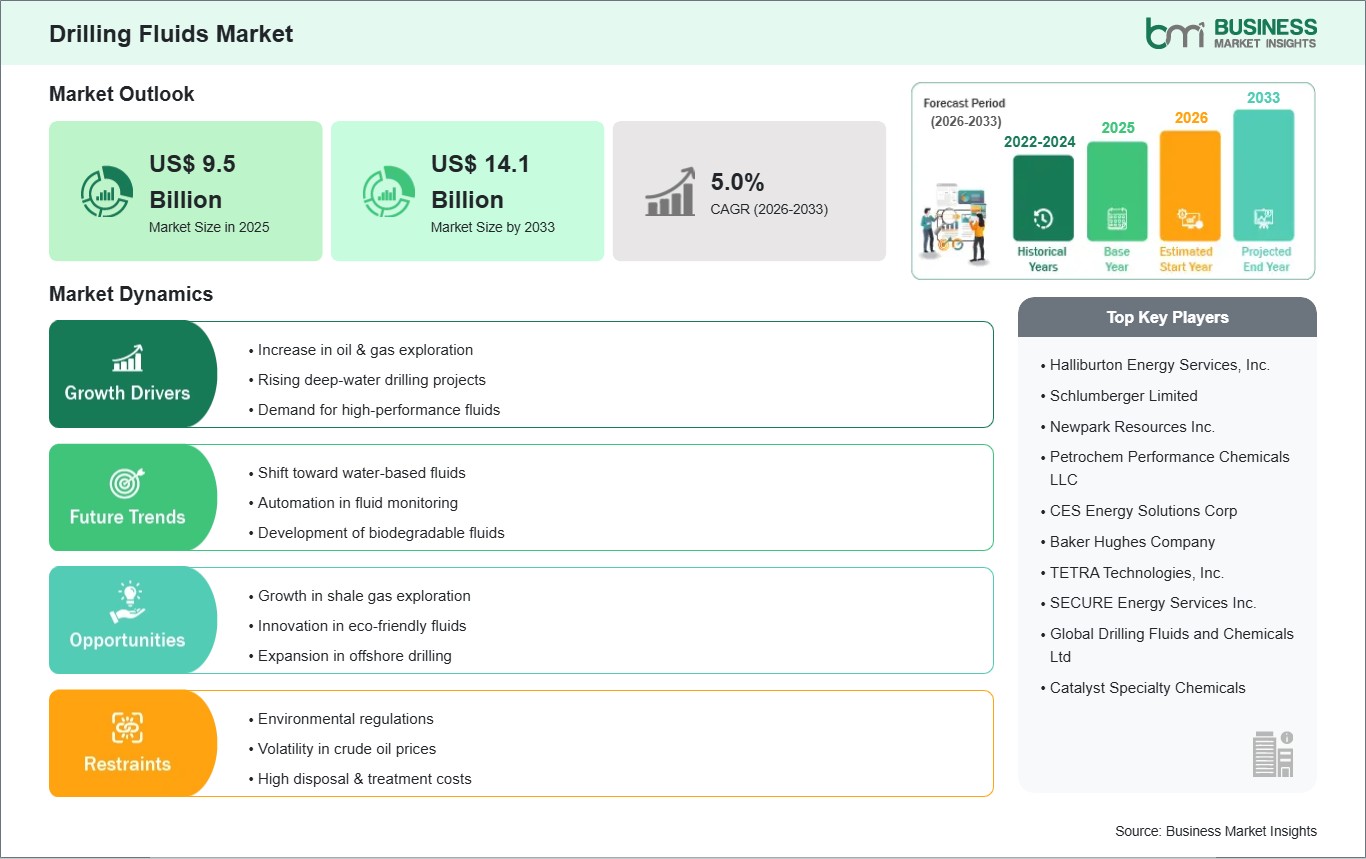
As per Business Market Insights, the global Drilling
Fluids Market is expected to increase from US$ 9.5 billion in 2025
to US$ 14.1 billion by 2033. This growth reflects a projected CAGR of 5.06%
throughout the forecast period of 2026–2033.
Advancements in additive chemistry, biodegradable base-oil
synthesis, and smart, real-time mud telemetry systems are rapidly reconfiguring
the competitive market landscape. Leading oilfield service providers and
international chemical developers are channeling substantial R&D capital
into expanding the operational windows of eco-friendly water-based and
synthetic-based systems. These strategic engineering efforts aim to achieve
optimal shale inhibition and robust wellbore integrity while successfully
complying with increasingly strict international environmental discharge
restrictions.
What Is a Drilling Fluid?
A drilling fluid is a highly engineered, multi-component
chemical and physical mixture circulated through a wellbore during oil, natural
gas, geothermal, or mining drilling procedures. Entering the well via the
interior hollow drill string and exiting back up the annular space between the
pipe and the formation wall, these fluids must possess highly specific, dynamic
rheological properties. Their primary composition typically relies on a
distinct continuous base liquid such as fresh water, saturated brine, diesel,
mineral oil, or synthetic linear alpha-olefins densely packed with
functional chemical additives including weighting agents like barite, polymers
for fluid-loss control, viscosifiers like bentonite clay, and localized
corrosion inhibitors.
The fundamental physical objective of a drilling fluid is to
balance external hydrostatic pressure against internal formation pressures to
prevent catastrophic well control incidents or blowouts. Simultaneously, the
fluid acts as a hydraulic conveyor, dynamically encapsulating heavy rock
cuttings and transporting them to surface solids-control equipment where the
mixture is filtered and recycled. By coating permeable formation zones with a
thin, impermeable filter cake, advanced drilling muds eliminate structural
wellbore collapse, lower mechanical torque and drag on steerable bottom-hole
assemblies, and protect sensitive hydrocarbon production zones from structural
fluid invasion.
Download Sample Report: https://www.businessmarketinsights.com/sample/BMIPUB00032584
Market Drivers
A primary driver accelerating the global Drilling Fluids
Industry is the Accelerating Development of Unconventional Shale and Tight Oil
Reservoirs. The continuous refinement of horizontal drilling and multi-stage
hydraulic fracturing, particularly across complex onshore basins, has vastly
expanded the total length of individual lateral wellbore segments. Because
navigating these extensive horizontal horizons exposes the equipment to
prolonged contact with highly reactive, water-sensitive shale layers, operators
require specialized, high-performance drilling fluids to prevent clay swelling,
manage hole enlargement, and dramatically reduce expensive non-productive time
(NPT) caused by stuck pipes.
The intensifying institutional shift toward Deepwater and
Ultra-Deepwater Offshore Exploration serves as another vital market driver. As
mature onshore fields experience natural depletion cycles, state-owned and
international energy corporations are expanding operations into complex
offshore blocks, such as those in the Gulf of Mexico, the North Sea, and the
pre-salt basins of Latin America. These maritime operations present severe
logistical and operational challenges, including subsea mud-line temperatures
nearing freezing alongside extremely high downhole pressures. These conditions
require the bulk deployment of synthetic-based fluid systems capable of
maintaining stable viscosity profiles and preventing gas hydrate formation
under extreme thermal stresses.
Market Segmentation
By Product Type
- Water-Based
Fluids (WBFs) (Including dispersed, non-dispersed, and advanced
high-performance water-based muds)
- Oil-Based
Fluids (OBFs) (Formulated with high-stability diesel or low-toxicity
mineral oil bases for premium lubrication)
- Synthetic-Based
Fluids (SBFs) (Utilizing biodegradable synthetic esters, ethers, and
polyalphaolefins for extreme offshore conditions)
- Synthetic
and Non-Aqueous Gas Systems (Including air, mist, and stable foam drilling
applications)
By Application
- Onshore
Drilling (Sustained by massive unconventional asset developments and
pad-drilling efficiency updates)
- Offshore
Drilling (Comprising shallow water, deepwater, and ultra-deepwater
exploration architectures)
By End-Use Industry
- Oil
& Gas Extraction (The foundational global consumption vertical for
both exploratory and production wells)
- Geothermal
Energy Drilling (Requiring ultra-high temperature fluid stabilities to tap
deep thermal reservoirs)
- Mining
& Mineral Exploration
- Infrastructure
& Trenchless Civil Construction
The Water-Based Fluids (WBFs) segment commanded the dominant
revenue and volume share of the global market matrix in 2025, accounting for
over 52% of global volume. This leading position is supported by its universal
cost-efficiency, ease of environmental handling, and widespread utilization
across standard top-hole onshore drilling intervals globally. Concurrently, the
Onshore Drilling application segment led the overall end-use footprint, while
the Offshore Synthetic-Based Fluids vertical is registering the fastest
projected compound growth rate due to escalating technical demands in complex
deepwater projects.
Regional Insights
- North
America commands the premier share of the global drilling fluids
market, driven by mature unconventional shale operations across the United
States and Canada. High rig density across the Permian, Delaware, and
Bakken basins, combined with intensive horizontal drilling and robust
regulatory compliance infrastructure, maintains a massive, non-cyclical
volume demand for advanced high-performance water-based and low-toxicity
oil-based fluids.
- Asia-Pacific represents
the fastest-growing regional market over the forecast timeline, capturing
a significant chunk of global volume expansion. Growth is heavily
accelerated by state-backed energy modernization programs, massive
infrastructure drilling projects in China and India, and rising
investments to commercialize deep shale gas reserves and coalbed methane
blocks to satisfy soaring local industrial energy demands.
- Europe maintains
a stable, premium market presence focused primarily on advanced offshore
applications across the North Sea corridor. Regional market dynamics are
closely governed by highly rigorous environmental protocols, such as the
OSPAR Convention, which heavily restricts chemical discharges and
continuously drives the local development of ultra-clean, highly
biodegradable synthetic fluids.
- Rest
of the World (Middle East & Africa and South America) is
demonstrating robust incremental growth patterns. Massive offshore
pre-salt expansions in Brazil, paired with major national oil company
expansions across the Persian Gulf and East Africa, are attracting heavy
capital investments to construct advanced regional fluid blending centers
and solid-control support infrastructure.
Top Players in the Industry
The competitive marketplace features a highly consolidated
ecosystem of multi-national oilfield service giants alongside specialized
chemical developers who utilize advanced chemical patents and integrated
rig-site solids control systems to secure long-term operator contracts.
- SLB
(Schlumberger Limited)
- Halliburton
Company
- Baker
Hughes Company
- Weatherford
International plc
- Newpark
Resources, Inc.
- Imerys
S.A.
- Tetra
Technologies, Inc.
- SECURE
Energy Services Inc.
- National
Oilwell Varco (NOV Inc.)
Technological Innovations
The industrial integration of Nanoparticle-Enhanced Fluid
Additives represents a massive technological milestone for modern drilling
fluid engineering. Conventional micro-sized additives frequently struggle to
seal the microscopic pore throats found in tight shale formations, allowing
fluid filtrate to migrate into the rock and cause structural destabilization or
wellbore collapse. By incorporating engineered nanoparticles such as
nano-silica, graphene oxide, or carbon nanotubes into the mud matrix,
material scientists can create a highly optimized physical barrier. These
ultra-fine particles seamlessly plug micro-fractures, drastically reduce fluid
loss, lower overall filter cake thickness, and provide exceptional thermal and
shear stability under extreme downhole environments.
Concurrently, the deployment of Automated Smart Rheology
Control and Real-Time Fluid Monitoring Systems is radically modernizing
rig-site efficiency. Historically, mud properties like density, viscosity, and
gel strength were measured manually by mud engineers at scheduled intervals,
creating lag times in identifying downhole fluid degradation. Next-generation
automated mud logging trailers utilize inline sensors and advanced ultrasonic
analytics to continuously track chemical variations in real time. This streaming
data feeds directly into machine-learning algorithms that instantly calculate
fluid hydraulics, automatically alerting operators or triggering digital dosing
pumps to adjust chemical concentrations, thereby preventing non-productive time
caused by wellbore breathing or sudden influxes.
Future Market Outlook
The future trajectory for the Drilling Fluids Market remains
highly resilient and positive. As global energy demands require exploration
teams to drill deeper, hotter, and more structurally tortuous well paths, the
global utilization of highly customized, high-performance fluid architectures
will steadily scale, transforming traditional reservoir extraction boundaries.
Future research and development capital will be heavily
directed toward the commercialization of fully circular, closed-loop mud
recycling systems to maximize chemical recovery and minimize environmental
footprint, the synthesis of bio-derived, zero-carbon base oils from renewable
agricultural side-streams, and the expansion of digital telestroke-style remote
mud monitoring frameworks. Strategic organizations that successfully optimize
fluid performance metrics while delivering verifiable low-toxicity and low-carbon
profiles will comfortably command long-term global market leadership.
Frequently Asked Questions (FAQs)
What product type currently dominates the global drilling
fluids market?
The Water-Based Fluids (WBFs) segment holds the absolute
largest market share, capturing over 52% of the market in 2025. This dominance
is driven by its universal cost-effectiveness, environmental compliance
advantages, and widespread application across standard onshore top-hole
intervals globally.
Why is the offshore synthetic-based fluids vertical
expanding so rapidly?
Synthetic-Based Fluids (SBFs) combine the high lubrication,
thermal stability, and shale-inhibition performance of traditional oil-based
muds with the superior biodegradability and low toxicity required for offshore
marine discharge compliance, making them essential for complex deepwater wells.
How do drilling fluids help prevent catastrophic wellbore
blowouts?
Drilling fluids utilize heavy weighting agents, such as
barite, to dynamically adjust the fluid's density. This allows the fluid column
to exert a precise outward hydrostatic pressure that counteracts and controls
internal high-pressure gas or oil zones within the formation.
Which geographic region leads the consumption of drilling
fluids?
North America commands the leading global market share,
supported by dense, high-volume horizontal drilling activities, unconventional
shale plays like the Permian Basin, and advanced subsea exploration projects
within the Gulf of Mexico.
Browse More Reports:
Ceramic Matrix Composites Market
About Us
Business Market Insights is a market research platform that
provides subscription service for industry and company reports. Our research
team has extensive professional expertise in domains such as Electronics &
Semiconductor; Aerospace & Defense; Automotive & Transportation; Energy
& Power; Healthcare; Manufacturing & Construction; Food &
Beverages; Chemicals & Materials; and Technology, Media, &
Telecommunications.
Contact Us
If you have any questions about this report or would like
further information, please contact us:
Contact person: Ankit Mathur
Email: sales@businessmarketinsights.com
Phone: +16467917070


Comments
Post a Comment