Global Antimicrobial Drugs Market Analysis with US$ 178.96 Billion Forecast by 2033
Scientific advancements and
evolving healthcare needs are reshaping the global Anti-Infective Agents
Industry. Rising incidences of bacterial, viral, fungal, and parasitic
infections, combined with increasing concerns surrounding drug-resistant
pathogens, are reinforcing the importance of innovative anti-infective
therapies in modern medical practice.
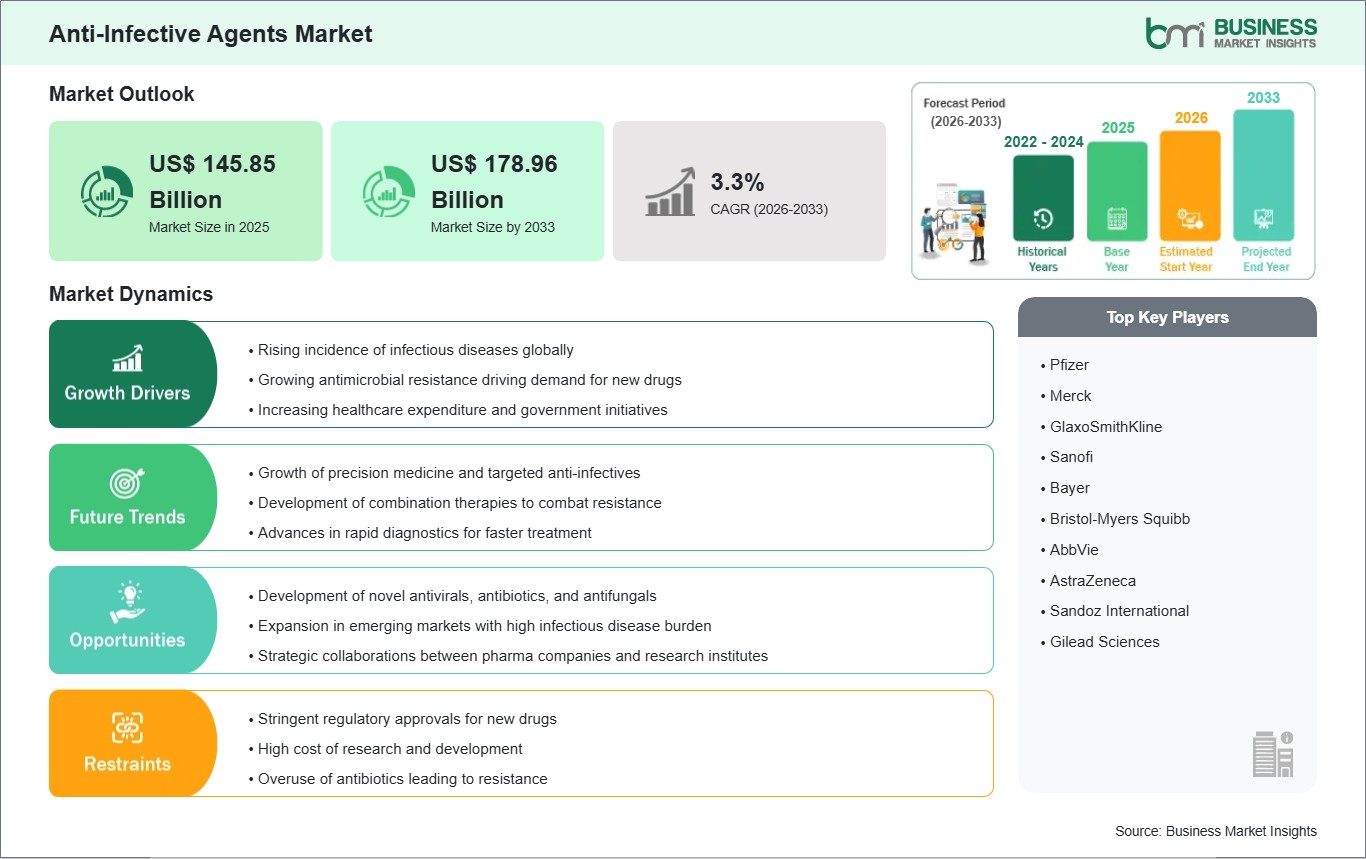
According to Business Market
Insights, the global Anti-Infective
Agents Market was valued at US$ 145.85 billion in 2025 and is
anticipated to reach US$ 178.96 billion by 2033. The market is projected to
grow at a CAGR of 2.59% during the forecast period from 2026 to 2033.
Advancements in artificial
intelligence-driven drug discovery, novel combination therapies, specialized
targeted delivery systems, and fast-tracked regulatory pathways are
significantly reshaping the global competitive landscape. Prominent
pharmaceutical conglomerates and biotechnology firms are aggressively focusing
R&D pipelines on addressing multi-drug resistant (MDR) and pan-drug
resistant (PDR) pathogens, which pose an existential threat to standard medical
procedures. These strategic investments are closely aligned with comprehensive
international antimicrobial stewardship programs designed to balance rapid
clinical deployment with the preservation of therapeutic efficacy across acute
care, institutional, and long-term community environments.
What Are Anti-Infective Agents?
Anti-infective agents are
specialized chemical substances or pharmacological compounds designed to
systematically inhibit the replication, disrupt the metabolic pathways, or
eliminate the cellular structure of pathogenic micro-organisms within a host
organism. Operating as indispensable therapeutic countermeasures, these agents
are engineered to exhibit selective toxicity minimizing host cellular
damage while maximizing the destruction of invading pathogens. This extensive
therapeutic umbrella is deeply integrated into every tier of clinical
intervention, functioning prophylactically to prevent perioperative infections
and curatively to resolve localized or systemic bloodstream infections.
The anti-infective landscape is
classified based on the target pathogen and corresponding mechanism of action.
Antibacterials (antibiotics) target bacterial structures, such as disrupting
cell wall synthesis via beta-lactams or inhibiting protein translation through
ribosomal binding. Antivirals interfere with viral replication cycles,
utilizing protease inhibitors or nucleoside analogues to arrest viral loads in
chronic conditions like HIV, hepatitis, and acute respiratory outbreaks.
Antifungals systematically degrade fungal cell membranes containing ergosterol,
while antiparasitics neutralize complex protozoal and helminthic vectors,
altogether forming a multi-tiered therapeutic shield across global clinical
pipelines.
Download Sample Report: https://www.businessmarketinsights.com/sample/BMIPUB00032647
Market Drivers
A primary driver accelerating the
global Anti-Infective Agents Industry is the Escalating Global Threat of
Antimicrobial Resistance (AMR) and Multi-Drug Resistant Strains. The historical
over-prescription and empirical misuse of broad-spectrum antibiotics have
accelerated natural bacterial mutation rates, culminating in the rise of highly
resilient pathogens like MRSA, VRE, and carbapenem-resistant
Enterobacteriaceae. Because these "superbugs" render standard
first-line therapies obsolete, international healthcare networks are forced to
procure advanced, high-margin reserve antibiotics and novel combination
therapies, driving substantial revenue expansion within the specialized
institutional segment.
The rapid expansion of the Global
Immunocompromised Patient Population and Advanced Surgical Procedures
represents another core market driver. The worldwide surge in multi-organ
transplantations, aggressive oncology chemotherapy regimens, and advanced autoimmune
therapies has created a vast patient demographic possessing severely depressed
immune systems. These individuals are exceptionally vulnerable to opportunistic
healthcare-associated infections (HAIs) and lethal systemic fungal conditions.
Consequently, institutional clinical networks are systematically expanding
their mandatory prophylactic anti-infective protocols, guaranteeing persistent,
high-volume demand for premium therapeutic lines across hospital groups
globally.
Furthermore, an increasing volume
of Public-Private R&D Funding Initiatives and Fast-Track Regulatory
Incentives is acting as a powerful growth catalyst. Legislative
frameworks such as the Generating Antibiotic Incentives Now (GAIN) Act and
Qualified Infectious Disease Product (QIDP) designations offer
pharmaceutical developers extended market exclusivity, streamlined clinical
trial phases, and prioritized regulatory review cycles. This favorable
financial and regulatory environment has effectively revitalized the
historically stagnant anti-infective research sector, incentivizing major
biotechnology firms to resume active discovery pipelines and launch
sophisticated molecular entities into the global market.
Market Segmentation
By Drug Type
- Antibaсterials
(Antibiotics) (Commands the leading volume share due to universal
application in routine clinical infections, though facing intense generic
pricing pressures)
- Antivirals
(The highest revenue-generating segment, propelled by long-term management
therapies for chronic viral diseases and post-pandemic safety stockpiling)
- Antifungals
(Tracking high compound growth driven by a rising incidence of invasive
candidiasis and aspergillosis among critical care patients)
- Antiparasitics
(Maintaining steady, localized volume patterns across tropical and
subtropical regions experiencing shifting vector distributions)
By Route of Administration
- Intravenous
(IV) (The dominant segment in acute care settings, critical for achieving
immediate, maximum systemic bioavailability in severe septic or
hospitalized states)
- Oral
(Widely preferred for outpatient care, chronic disease management, and
standard step-down therapeutic transitions)
- Topical
and Other Routes (Utilized for localized dermatological, ophthalmic, and
respiratory anti-infective delivery applications)
By Application
- Hospital-Acquired
Infections (HAIs) (A massive therapeutic vertical focus, addressing
central line infections, ventilator-associated pneumonia, and surgical
site contamination)
- Community-Acquired
Infections (Sustaining highly stable, non-cyclical baseline volumes across
standard respiratory, urinary, and gastrointestinal tracts)
- Other
Applications (Including preventative pediatric prophylactic regimens and
long-term travel medicine interventions)
By End-User
- Hospitals
and Clinics (The dominant procurement and administration channel, managing
high-concentration distribution networks and reserve-class formulary
lists)
- Ambulatory
Care Centers and Pharmacies (Experiencing rapid expansion due to the
steady transition toward outpatient clinics and localized long-term care
management)
The Antivirals segment held the
largest revenue share of the market matrix in 2025, driven by the premium
pricing structures associated with long-term viral suppression regimens and
high-demand prophylactic therapies. Simultaneously, the Intravenous (IV)
segment led the administration matrix due to the clinical necessity of direct
vascular access in severe, acute institutional infections, while the Hospital
End-User sector continues to command the largest overall purchasing power
globally.
Regional Insights
- North
America holds the premier revenue share of the global
anti-infective agents market, controlling a significant portion of the
total geographic matrix. This leadership is sustained by high per-capita
healthcare expenditure, a mature framework of antimicrobial stewardship
programs, and substantial federal funding for biodefense and pandemic
readiness. The immediate clinical adoption of high-cost, newly approved
molecular entities solidifies the region as the primary hub for premium
value generation.
- Europe maintains
a highly regulated, substantial market presence, characterized by strict
centralized oversight via the European Medicines Agency (EMA) and an
intensive institutional focus on limiting broad-spectrum antibiotic
overuse. Regional expansion across Germany, France, and the UK centers
tightly on value-based procurement contracts, standardized clinical
guidelines, and publicly funded cross-border research alliances aimed at
combating multi-drug resistance.
- Asia-Pacific represents
the fastest-growing geographic block, recording an exceptional forward
trajectory during the forecast period. Driven by rapid healthcare
modernizations, expanding public health insurance schemes, a high baseline
density of infectious diseases, and expanding pharmaceutical production
capabilities across China and India, this region is generating immense
volume requirements. Multinational firms are actively forming local
distribution ventures to capitalize on the rapid expansion of medical
infrastructure.
- Rest
of the World (Middle East & Africa and South America) is
demonstrating steady, progressive expansion patterns. Growth across South
America is anchored by expanding public health infrastructure in Brazil,
while the Middle East is recording an uptick in premium critical care
facilities, driven by a regional focus on self-reliance in pharmaceutical
manufacturing and advanced clinical infection control.
Top Players in the
Anti-Infective Agents Industry
The industrial landscape features
high corporate consolidation among top-tier global pharmaceutical
conglomerates, balanced by a highly specialized network of clinical-stage
biotechnology firms managing targeted molecular pipelines.
- Pfizer
Inc.
- Merck
& Co., Inc.
- GlaxoSmithKline
plc
- F.
Hoffmann-La Roche Ltd
- Novartis
AG
- Sanofi
- Gilead
Sciences, Inc.
- AstraZeneca
plc
- Shionogi
& Co., Ltd.
- Viatris
Inc.
Technological and Clinical
Innovations
The implementation of Artificial
Intelligence (AI) and Machine Learning Algorithms in Novel Molecular Screening
represents a monumental technological breakthrough for the anti-infective
sector. Historically, traditional phenotypic and genomic screening methods
required years of laboratory experimentation, frequently resulting in high
attrition rates and exorbitant development costs. Modern drug discovery
platforms leverage advanced deep-learning models to screen billions of
synthetic and natural chemical structures in silico within days. These systems
precisely predict a compound's ability to disrupt structural pathogen targets
while ensuring minimal mammalian cell toxicity, effectively shortening the
pre-clinical development phase and introducing entirely unique chemical classes
to combat resistant pathogens.
Concurrently, the clinical
development of Advanced Combination Therapeutics and Monoclonal Antibody
Pairings has fundamentally revolutionized the management of complex infections.
To circumvent rapid resistance development, modern therapeutic designs combine
established anti-infective backbones with innovative beta-lactamase inhibitors
or adjunctive targeted monoclonal antibodies. This dual-action approach
neutralizes the pathogen's primary enzymatic defense mechanisms simultaneously,
restoring full clinical efficacy to standard therapies and providing highly
specialized, targeted defense vectors that successfully clear severe systemic
infections without inducing widespread microbial mutations.
Future Market Outlook
The future trajectory for the
Anti-Infective Agents Market remains exceptionally robust. As global health
models permanently prioritize defensive readiness against emerging biological
strains and clinical networks continue to demand highly specific, resistance-resistant
therapeutic choices, the global volume consumption of advanced antivirals,
antifungals, and reserve-class antibacterials will scale continuously,
establishing the benchmarks of modern disease control.
Future research and development
capital will be heavily directed toward the commercialization of fully
personalized anti-infective therapies guided by rapid companion diagnostics,
the deployment of peptide-based membrane disruptors that physically eradicate
bacterial cells, and the expansion of smart, time-released oral formulations
designed to maintain precise therapeutic windows in outpatient environments.
Organizations that successfully align their development pipelines with rapid
point-of-care susceptibility testing will comfortably secure long-term global
market leadership.
Frequently Asked Questions
(FAQs)
What primary factor is driving
the rapid revenue expansion within the anti-infective agents market?
The primary driver is the alarming
rise of antimicrobial resistance (AMR) and multi-drug resistant superbugs
globally. This critical shift forces healthcare institutions to transition away
from low-cost generic antibiotics and procure advanced, higher-margin
reserve-class therapies to resolve life-threatening clinical infections.
Why does the Antivirals segment
command the largest revenue share in the market matrix?
The Antivirals segment leads the
market in value due to the premium pricing structures and long-term,
non-cyclical consumption patterns associated with chronic viral suppression
regimens (such as HIV and Hepatitis B/C management) alongside continuous institutional
pandemic stockpiling initiatives.
How do public-private
legislative incentives like the GAIN Act impact drug development?
Incentives like the GAIN Act
provide critical advantages to pharmaceutical firms, including extended market
exclusivity and fast-tracked regulatory reviews for newly discovered infectious
disease products. This significantly enhances the financial viability of
anti-infective R&D pipelines.
Which geographic territory is
recording the fastest compound growth rate for anti-infective solutions?
The Asia-Pacific region is
tracking the fastest projected compound annual growth rate (CAGR), propelled by
massive hospital infrastructure expansions, rising disposable income, expanding
public insurance coverage, and a high regional patient density requiring
efficient infection control.
Browse More Reports:
About Us
Business Market Insights is a
market research platform that provides subscription service for industry and
company reports. Our research team has extensive professional expertise in
domains such as Electronics & Semiconductor; Aerospace & Defense;
Automotive & Transportation; Energy & Power; Healthcare; Manufacturing
& Construction; Food & Beverages; Chemicals & Materials; and
Technology, Media, & Telecommunications.
Contact Us
If you have any questions about
this report or would like further information, please contact us:
Contact person: Ankit Mathur
Email: sales@businessmarketinsights.com
Phone: +16467917070


Comments
Post a Comment