Global Isocyanates Market Analysis with US$ 7.8 Billion Forecast by 2033
Growing demand for polyurethane-based products is driving the continued advancement of the global Toluene Diisocyanate (TDI) Industry. Key growth factors include rising consumption of flexible foams in furniture and bedding applications, increasing use in automotive interiors, and expanding demand for insulation materials within the construction sector.
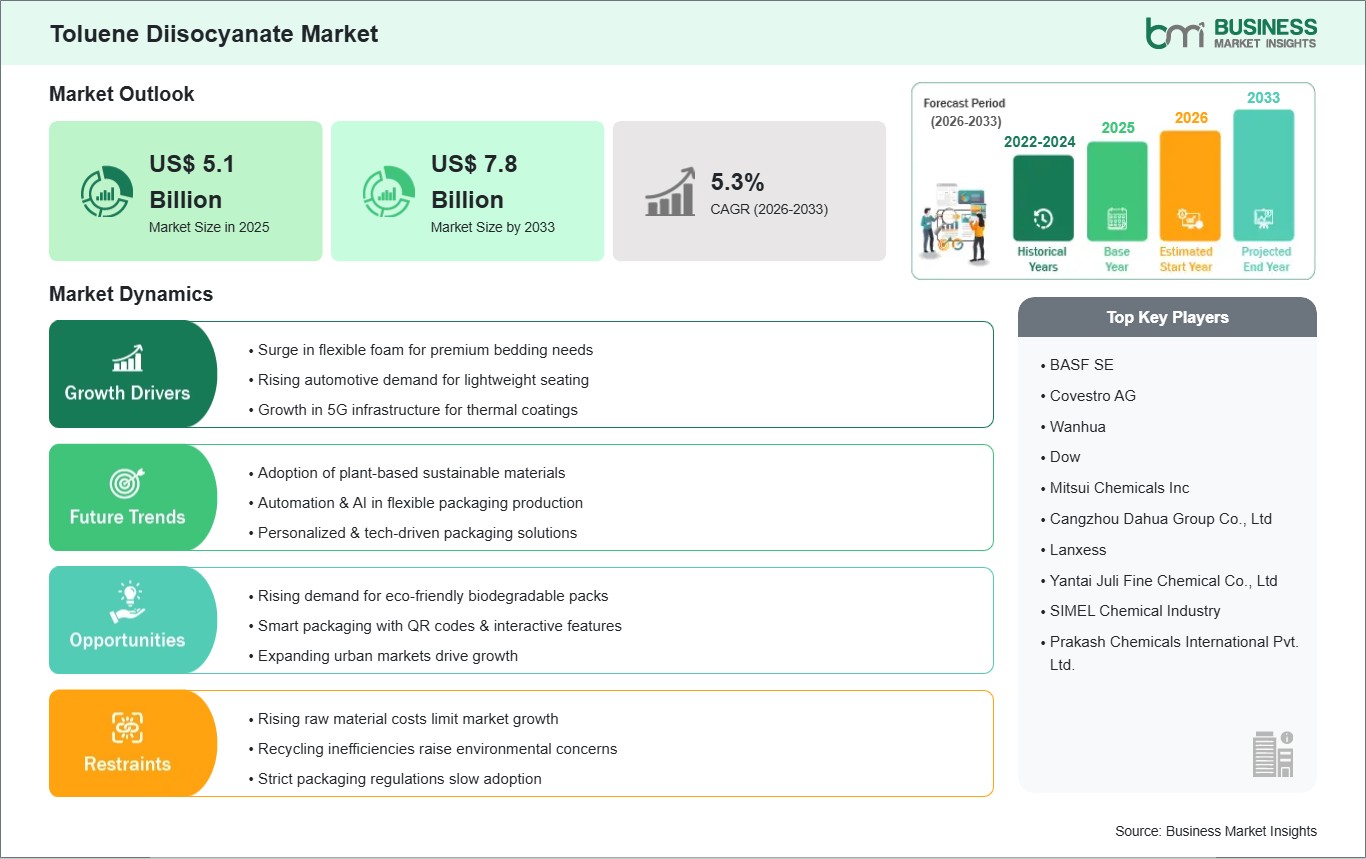
Business Market Insights projects the global Toluene
Diisocyanate Market to grow steadily, reaching US$ 7.8 billion by
2033 from US$ 5.1 billion in 2025. The market is expected to record a CAGR of
5.45% over the forecast period spanning 2026 to 2033.
Advancements in product performance, process improvements,
and the development of lower-emission production routes are continuously
reshaping the competitive landscape. Leading global chemical conglomerates are
prioritizing capital efficiency and strategic supply chain localization to
offset volatile feedstock prices. By aligning manufacturing capacities with
rapid downstream demand in expanding urban clusters, industry participants are
securing sustained profitability across highly competitive regional blocks.
What Is Toluene Diisocyanate?
Toluene Diisocyanate (TDI) is a highly reactive aromatic
diisocyanate chemical intermediate that is fundamentally essential for
synthesizing flexible polyurethane polymers. Commercially manufactured through
a multi-step process involving the nitration of toluene to yield
dinitrotoluene, followed by catalytic hydrogenation to form toluene diamine,
and final phosgenation, TDI exists primarily in two main isomers: 2,4-TDI and
2,6-TDI. The most globally ubiquitous formulation is TDI 80/20, a specific
blend of 80% 2,4-isomer and 20% 2,6-isomer, which commands the largest volume
of global industrial consumption.
TDI delivers profound performance advantages over
traditional cushioning and insulation alternatives by imparting exceptional
mechanical elasticity, superior load-bearing capacity, and outstanding physical
resilience to the final polymer matrix. Its inherently lower viscosity and
rapid reactivity grant critical processing benefits that ensure highly uniform
cell structures, enhanced tear resistance, and optimal compression sets in
advanced foam manufacturing. This versatility allows industrial converters to
seamlessly customize foam densities and create specialized formulations
tailored for demanding residential, commercial, and transportation systems.
Download Sample Report: https://www.businessmarketinsights.com/sample/BMIPUB00032577
Market Drivers
A primary driver accelerating the global Toluene
Diisocyanate Industry is the Rising Urbanization and Premium Comfort Demand in
Furniture and Bedding sectors. Rapid global population expansion, growing
middle-class disposable income, and continuous residential and commercial
housing developments particularly within emerging markets have created an
immense need for flexible polyurethane foams. Because TDI serves as the primary
chemical anchor for manufacturing mattresses, high-resilience upholstered seating,
and ergonomic pillows, shifting consumer preferences toward long-lasting
comfort products provide a robust, reliable volume base for global TDI
consumption.
The intensifying focus on Automotive Interior Lightweighting
and Acoustic Insulation serves as another vital market driver. Global
automotive original equipment manufacturers (OEMs) are increasingly
incorporating high-performance polyurethane systems to reduce overall vehicle
mass, which directly cuts carbon emissions for internal combustion engines and
extends the driving range of electric vehicles (EVs). Vehicle manufacturers
utilize TDI-rich flexible foams for seat cushions, integrated head restraints,
headliners, and complex vibration-dampening panels because the material
successfully trims weight while maximizing passenger impact protection and
cabin sound isolation.
Furthermore, stringent Energy-Efficiency Building Codes and
Infrastructure Modernization initiatives are expanding the market footprint.
Modern structural engineering practices increasingly emphasize thermal envelope
performance to reduce municipal energy expenditure. Consequently, TDI-based
coatings, adhesives, sealants, and elastomers (CASE) are experiencing broad
market penetration. These specialized chemical systems offer exceptional
weather-proofing, cross-linking density, and corrosion resistance, making them
invaluable for structural bonding, protective architectural finishes, and
energy-efficient building envelopes.
Market Segmentation
By Application
- Flexible
Polyurethane Foam (The dominant product form heavily integrated into
lifestyle and seating cushioning)
- Rigid
Polyurethane Foam (Utilized for structural thermal barriers and
refrigeration panels)
- Coatings,
Adhesives, Sealants, and Elastomers (CASE) (High-performance chemical
systems for industrial bonding and surface protection)
By End-Use Industry
- Furniture
& Interiors (The largest overall consumption vertical for comfort and
bedding applications)
- Automotive
& Transportation (Fastest-growing end-use sector supporting vehicle
lightweighting and EV thermal-acoustic solutions)
- Construction
(Driven by infrastructure investments and energy-efficient building
requirements)
- Electronics
& Packaging (Utilized for shock-absorbing foam inserts and delicate
component coatings)
- Textiles
& Others (Including synthetic leather backings and specialized
industrial compounds)
The Flexible Polyurethane Foam application segment commanded
the absolute largest revenue share of the global market matrix in 2025,
maintaining its long-standing position as the principal driver of difunctional
aromatic isocyanates due to robust international furniture and bedding trends.
Concurrently, the Furniture & Interiors sector led the end-use market
share, while the Automotive & Transportation vertical is recording the
highest projected compound growth, driven by escalating material-performance
requirements in modern electric vehicle platforms.
Regional Insights
- Asia-Pacific commands
the largest share of the global toluene diisocyanate market, holding
approximately 45% of the total geographic matrix. This dominant presence
is sustained by abundant natural feedstock availability, lower production
overheads, and extensive state-backed industrial corridors across China
and India. Widespread urbanization, rising middle-class disposable
incomes, and a flourishing domestic manufacturing hub make Asia-Pacific
the primary focal point for global foreign direct investment (FDI) and
capacity additions.
- Europe maintains
a substantial and highly regulated market footprint, capturing roughly 30%
of global demand. Regional market dynamics are heavily shaped by strict
compliance with European chemical safety frameworks and an industrial
focus on formulating low-VOC, ultra-low-emission specialty polyurethanes.
Growth in this region is primarily replacement-oriented and centers on
advanced construction insulation and premium automotive applications.
- North
America represents a premium, value-driven market block, holding
an estimated 18% share. Market expansion across the United States and
Canada is propelled by a mature polyurethane manufacturing sector,
expanding infrastructure renewal projects, and strong corporate
investments in advanced, high-performance coatings and structural
adhesives.
- Rest
of the World (Middle East & Africa and South America) is
demonstrating gradual, steady adoption patterns. Market development in
these regions is supported by localized smart city infrastructure
investments, expanding commercial hospitality construction, and growing
automotive assembly networks that elevate regional requirements for bulk
chemical intermediates.
Top Players in the Toluene Diisocyanate Industry
The competitive ecosystem is characterized by a high level
of market concentration among major multi-national chemical technology
conglomerates that manage fully integrated upstream supply chains and global
distribution networks.
- BASF
SE
- Covestro
AG
- Wanhua
Chemical Group Co., Ltd.
- Dow
- Mitsui
Chemicals Inc.
- Tosoh
Corporation
- Yantai
Juli Fine Chemical Co., Ltd.
- SABIC
(Saudi Basic Industries Corporation)
Technological Innovations
The industrial scale-up of Phosgene-Free TDI Production
Technologies represents a massive technological milestone for chemical
engineering. Traditionally, the synthesis of toluene diisocyanate relies on a
phosgenation route, which presents significant hazardous material transport,
storage, and occupational safety challenges. Next-generation manufacturing
processes are shifting toward non-phosgene alternative pathways, such as the
direct liquid-phase carbonylation of toluene diamine with dimethyl carbonate. This
breakthrough drastically reduces severe environmental exposure risks,
simplifies industrial plant safety compliance profiles, and lowers processing
capital expenditure over traditional setups.
Concurrently, material scientists are successfully deploying
Advanced Low-Emission and Bio-Based Polyurethane Foam Formulations to meet
modern environmental criteria. Downstream foam manufacturers are utilizing
optimized TDI components paired with bio-polyols derived from natural oil
feedstocks like castor or soybean oil. These innovative chemical matrixes
eliminate volatile organic compound (VOC) emissions within vehicle passenger
cabins and residential living spaces, delivering exceptional mechanical performance,
flame-retardant properties, and high compression sets while substantially
lowering the overall carbon footprint of final lifestyle consumer goods.
Future Market Outlook
The future trajectory for the Toluene Diisocyanate Market
remains robust and highly resilient. As global construction codes permanently
mandate energy efficiency and global transport sectors move aggressively toward
vehicle weight reduction, the integration of high-performance polyurethane
systems will steadily expand, preserving TDI's position as a fundamental
volume-driven industrial asset.
Future research and development capital will be heavily
directed toward the commercialization of fully circular polyurethane recycling
pathways to extract raw chemical intermediates back from post-consumer foam
waste, the optimization of advanced catalyst packages to improve raw material
conversion efficiency, and the execution of margin optimization strategies
across key manufacturing plants. Organizations that successfully balance scale
and supply chain localization while offering advanced, eco-friendly low-VOC
chemical grades will comfortably command long-term global market leadership.
Frequently Asked Questions (FAQs)
What application type currently dominates the global
toluene diisocyanate market?
The Flexible Polyurethane Foam segment holds the absolute
largest market share. This dominant presence is driven by the universal
utilization of flexible foams as the core cushioning material within the global
bedding, residential upholstery, and automotive seating sectors.
What factors are primary growth drivers for the
automotive end-use segment?
The automotive vertical is expanding due to an intense
industry focus on vehicle lightweighting to improve fuel economy and electric
vehicle battery driving ranges. TDI-based foams cut vehicle interior component
mass while ensuring superior acoustic insulation and structural comfort.
How are regulatory safety standards impacting the global
TDI supply chain?
TDI is classified as a respiratory sensitizer, leading to
highly stringent occupational exposure limits enforced by bodies like OSHA and
European regulators. These stringent worker-safety rules increase compliance
and handling costs, encouraging producers to invest heavily in low-emission
formulations and advanced automated processing systems.
Which regional block leads global toluene diisocyanate
consumption and production?
The Asia-Pacific region leads the global market, accounting
for approximately 45% of total market value. This leadership is sustained by
massive production capacities in China, rapid regional urbanization, expanding
private housing construction, and low-cost labor frameworks attracting
extensive investments.
Browse More Reports:
Automotive Plastic Additives Market
About Us
Business Market Insights is a market research platform that
provides subscription service for industry and company reports. Our research
team has extensive professional expertise in domains such as Electronics &
Semiconductor; Aerospace & Defense; Automotive & Transportation; Energy
& Power; Healthcare; Manufacturing & Construction; Food &
Beverages; Chemicals & Materials; and Technology, Media, &
Telecommunications.
Contact Us
If you have any questions about this report or would like
further information, please contact us:
Contact person: Ankit Mathur
Email: sales@businessmarketinsights.com
Phone: +16467917070


Comments
Post a Comment