Ophthalmic Lasers Market Set for Steady Growth at 6.09% CAGR by 2033
Global advancements in eye care and surgical technologies are driving the evolution of the Ophthalmic Lasers Industry. Key growth factors include the expanding geriatric population, rising burden of age-related ocular disorders, and growing preference for minimally invasive laser-assisted procedures that improve precision, reduce complications, and enhance visual outcomes.
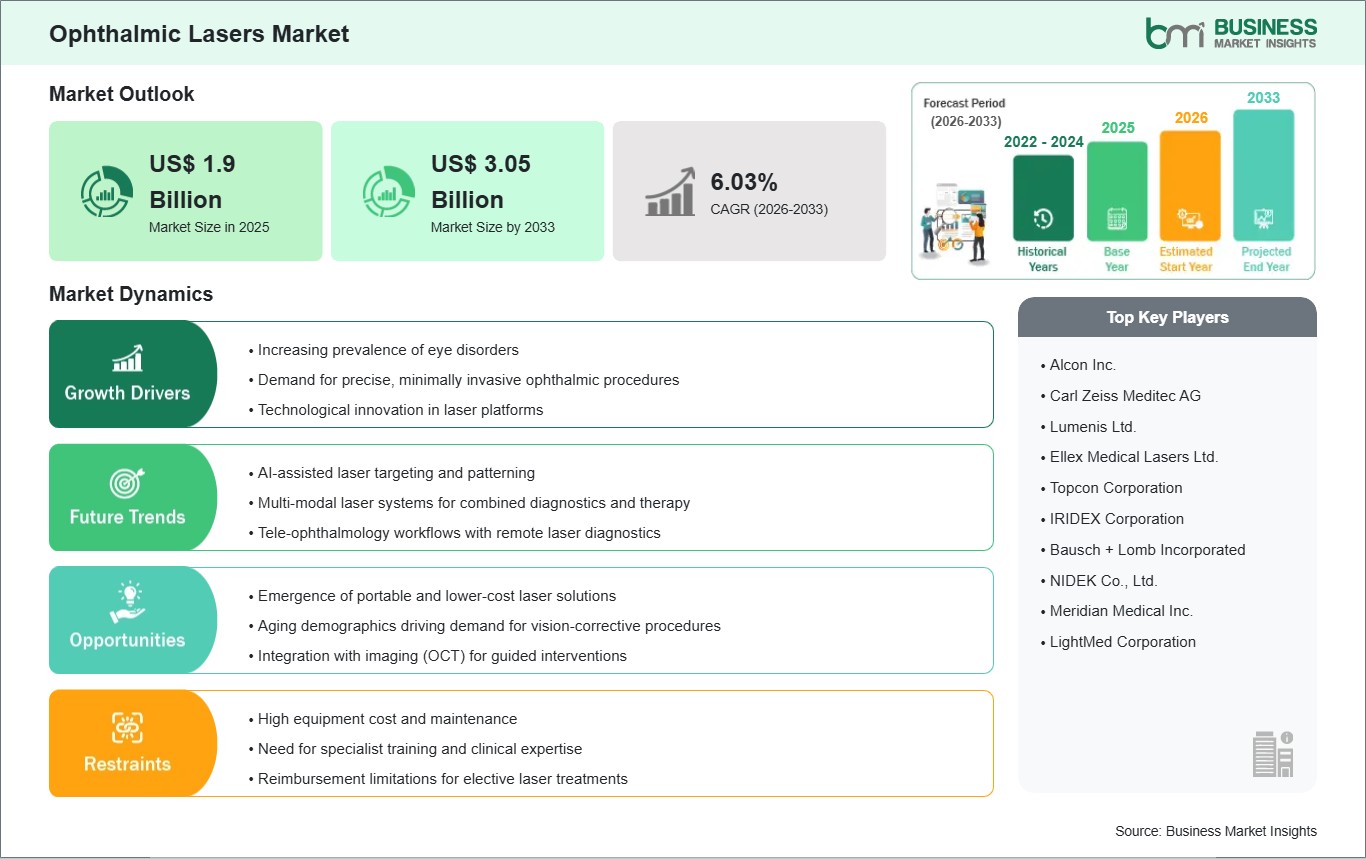
Business Market Insights projects the global Ophthalmic
Lasers Market to grow steadily, reaching US$ 3.05 billion by 2033
from US$ 1.9 billion in 2025. The market is expected to record a CAGR of 6.09%
over the forecast period spanning 2026 to 2033.
Advancements in solid-state laser matrices, intraoperative
optical coherence tomography (OCT) integration, automated tracking algorithms,
and multi-wavelength scanning configurations are rapidly shifting the
competitive environment. Leading medical engineering firms are funneling
substantial capital into optimizing pulse durations down to the femtosecond
level, improving real-time corneal mapping diagnostics, and refining automated
ablation patterns. These innovations are specifically engineered to mitigate
collateral thermal damage to surrounding ocular tissues, eliminate physical
incisional risks, and provide intuitive, customized surgical tracking control
for ophthalmic surgeons managing delicate intraocular structures.
What Is an Ophthalmic Laser?
An ophthalmic laser is a highly engineered medical optical
device designed to emit intense, highly focused beams of coherent monochromatic
light precisely calibrated to interact with specialized structural layers of
the human eye. Far exceeding standard surgical instruments, these platforms
function as non-contact micro-surgical tools capable of cutting, reshaping,
photo-disrupting, or photocoagulating ocular tissues at micron-level
tolerances. They feature advanced structural attributes such as high-definition
slit-lamp delivery optics, digitized multi-axis scanning mirrors, precision
aiming beams, and dynamic thermal management modules engineered to sustain
uniform energy delivery across rapid firing cycles.
These surgical platforms operate across highly distinct
wavelengths and pulse widths to suit specific clinical profiles. Excimer and
Femtosecond lasers operate in the ultraviolet and near-infrared spectrums using
ultra-short pulse delivery to execute non-thermal molecular bond disruptions,
making them highly optimal for precise corneal reshaping in refractive
procedures or creating seamless corneal incisions during cataract surgery.
Conversely, Nd:YAG and Diode laser systems generate specialized photothermal or
photodisruptive energy configurations to create structural openings in the
posterior capsule or perform targeted retinal photocoagulation, allowing
clinical care teams to effectively manage progressive glaucoma and advanced
diabetic retinopathy complications without structural eye trauma.
Download Sample Report: https://www.businessmarketinsights.com/sample/BMIPUB00032661
Market Drivers
A primary driver accelerating the global Ophthalmic Lasers
Industry is the Escalating Global Burden of Chronic Ocular Disorders and
Age-Related Vision Loss. The worldwide population aged 60 years and older is
expanding at an unprecedented rate, naturally correlating with a higher
clinical prevalence of severe cataracts, primary open-angle glaucoma, and
age-related macular degeneration (AMD). Because untreated visual impairment
profoundly restricts independent daily functioning and reduces overall patient
life quality, private medical facilities and public healthcare groups are
systematically investing in high-throughput ophthalmic laser systems to provide
rapid, vision-saving surgical interventions on an expanded scale.
The global surge in Metabolic Syndromes, Type-2 Diabetes,
and Subsequent Diabetic Retinopathy cases represents another core market
driver. Uncontrolled chronic hyperglycemia induces microvascular degradation
within the delicate retinal tissue bed, leading to diabetic retinopathy a
primary cause of preventable blindness among working-age populations. Managing
this expanding patient demographic requires widespread deployment of targeted
pan-retinal photocoagulation therapies. Specialized multi-spot green and yellow
laser systems are heavily procured by clinical networks to systematically seal
leaking retinal capillaries, inhibit abnormal neovascularization, and preserve
structural vision metrics for millions of diabetic patients globally.
Additionally, the paradigm shift toward Minimally Invasive
Elective Procedures and Ambulatory Healthcare Infrastructures acts as a
powerful catalyst. Modern consumers and healthcare payers increasingly reject
conventional mechanical blade-based surgeries due to risks of post-operative
structural infection, prolonged corneal inflammation, and extensive recovery
timelines. Ophthalmic laser platforms optimize surgical workflows by enabling
blade-free, bloodless procedures that achieve exceptional predictability. This
dynamic allows specialized eye clinics and ambulatory surgical centers (ASCs)
to drastically compress operational times, minimize complications, and maximize
daily patient throughput volumes.
Market Segmentation
By Product
- Femtosecond
Lasers (Dominating the technological landscape due to extreme precision in
blade-free cataract surgeries and advanced corneal flaps)
- Excimer
Lasers (Maintaining a strong market footprint tied directly to high-volume
refractive adjustments and surface ablation procedures)
- Diode
Lasers (Widely utilized for targeted retinal photocoagulation therapies
and localized transscleral cyclophotocoagulation)
- Nd:YAG
Lasers (A foundational clinical instrument preferred for posterior
capsulotomy and peripheral iridotomy procedures)
- SLT
Lasers (Expanding steadily as a premier non-invasive first-line
intervention for reducing elevated intraocular pressure in glaucoma)
- Other
Products (Including multi-wavelength gas lasers and emerging solid-state
therapeutic models)
By Application
- Refractive
Error Correction (Leading the commercial revenue matrix driven by massive
elective global demand for LASIK, PRK, and SMILE procedures)
- Cataract
Removal (Experiencing consistent high-volume expansion through
laser-assisted lens fragmentation and capsulorhexis automation)
- Glaucoma
(Tracking a steady upward path via non-invasive trabeculoplasty treatments
to optimize aqueous humor outflow)
- Diabetic
Retinopathy (Demanding consistent therapeutic procurement to address
progressive microvascular retinal damage)
- Age-related
Macular Degeneration (Utilizing specialized photodynamic laser therapies
to limit subretinal vascular leakage)
- Other
Applications (Encompassing localized ocular oncology treatments and
specialized vitreoretinal membrane alterations)
By End-User
- Outpatient
Facilities (The dominant revenue-generating end-user segment, powered by
the rapid proliferation of specialized ambulatory surgical centers and
private eye clinics)
- Inpatient
Facilities (Utilizing heavy-duty, multi-platform laser installations
within major public hospitals and academic medical institutions)
Regional Insights
- North
America holds the premier position in the global landscape,
securing a commanding revenue share. This market dominance is anchored by
high per-capita healthcare expenditure, comprehensive medical insurance
coverage frameworks that accommodate advanced laser optics, and a rapid
clinical adoption rate for newly approved premium solid-state
configurations across the United States and Canada.
- Europe exhibits
a highly regulated, substantial market presence, heavily supported by
well-funded public health networks and progressive universal diagnostic
screening frameworks across Germany, the UK, and France. European eye
clinics prioritize strict CE-marked ergonomic certifications and
integrated diagnostic pairings to optimize patient safety and clinical
outcome trackability.
- Asia-Pacific represents
the fastest-growing geographic block, recording an exceptional forward
growth path. This rapid expansion is propelled by massive healthcare
modernization campaigns, expanding public medical access, a high regional
baseline of myopia, and aggressive investments in specialized eye
hospitals across China, India, and Japan.
- Rest
of the World (Middle East & Africa and South America) is
displaying steady, progressive growth patterns, driven by the targeted
modernization of private specialty hospitals, expanding urban clinic
networks, and public-private healthcare initiatives designed to scale up
regional eye care capabilities.
Top Players in the Industry
The competitive ecosystem displays a focused framework, with
specialized medical optics conglomerates and high-tech laser engineering firms
maintaining clear leadership through long-term group purchasing organization
(GPO) contracts and extensive technical patents.
- Alcon
Inc.
- Carl
Zeiss Meditec AG
- Lumenis
Be Ltd.
- NIDEK
Co., Ltd.
- IRIDEX
Corporation
- Topcon
Corporation
- Lumibird
Group (Quantel Medical)
- Ellex
Medical Lasers
- Bausch
+ Lomb Corporation
- Ziemer
Ophthalmic Systems AG
Technological Innovations
The integration of Intraoperative Optical Coherence
Tomography (OCT) Guided Navigation represents a monumental structural
breakthrough for ophthalmic laser platforms. Historically, surgeons relied on
pre-operative static diagnostic images to map out surgical plans, which could
introduce alignment variances due to subtle patient movement or eye positioning
shifts on the operating table. Next-generation ophthalmic lasers combine
real-time cross-sectional OCT visualization directly into the laser delivery system.
This allows the laser to automatically adjust its focus and depth parameters
mid-procedure, ensuring micron-level ablation accuracy through changing corneal
structures and providing a level of safety and precision previously unavailable
in conventional mechanical techniques.
Concurrently, the transition toward Intelligent AI-Driven
Ablation Profiling and Automated Eye Tracking Systems is completely modernizing
the refractive sector. Next-generation excimer and femtosecond setups
incorporate sophisticated high-speed camera arrays that monitor involuntary
micro-saccadic eye movements thousands of times per second. If the patient's
eye shifts even a fraction of a millimeter, the integrated machine learning
algorithms instantly recalculate the laser path or pause energy delivery dynamically.
This eliminates the risk of decentered ablations, reduces surgical human error
factors, and delivers highly customized treatment paths tailored to the unique
topography of each patient's eye.
Future Market Outlook
The long-term trajectory for the Ophthalmic Lasers Market
remains exceptionally strong. As international healthcare guidelines
permanently establish minimally invasive optical intervention as a core metric
of clinical excellence and global demographic trends continue to expand the
baseline population requiring precise vision preservation, the universal demand
for both therapeutic and corrective laser systems will scale continuously,
defining point-of-care efficiency protocols.
Future research and development capital will be heavily
directed toward the commercialization of ultra-compact, multi-wavelength mobile
laser modules that facilitate remote clinical delivery, the integration of
advanced robotic-assisted alignment arms to optimize surgical docking
procedures, and the expansion of smart, non-thermal photo-disruptive solutions
for pre-presbyopic lens treatments. Equipment developers that successfully
balance premium real-time diagnostic integration with competitive, compact structural
profiles will comfortably secure long-term global market leadership.
Frequently Asked Questions (FAQs)
What product category currently commands the dominant
position in the global ophthalmic lasers market?
The Femtosecond Lasers segment holds the leading revenue and
technology share, driven by their unmatched micro-level incision accuracy,
non-thermal cutting mechanics, and ubiquitous deployment across advanced
cataract extractions and blade-free LASIK surgeries globally.
Why are outpatient facilities experiencing the fastest
procurement growth for ophthalmic lasers?
Outpatient facilities, such as ambulatory surgical centers
(ASCs), are leading procurement because ophthalmic laser procedures are highly
efficient, require zero overnight stays, and feature rapid patient recovery
profiles, making them perfectly suited for high-volume, same-day specialty
clinic workflows.
How does intraoperative OCT integration enhance patient
safety during laser procedures?
Intraoperative OCT integration provides the surgeon with
continuous, real-time cross-sectional visualizations of ocular tissue layers
during the actual procedure. This allows the laser platform to dynamically
verify structural depth, preventing accidental tissue over-penetration and
maximizing alignment safety.
Which geographic territory is recording the fastest
compound growth rate for ophthalmic solutions?
The Asia-Pacific region is tracking the fastest projected
compound annual growth rate (CAGR), propelled by massive healthcare
infrastructure modernizations, escalating regional myopia rates among younger
demographics, rising disposable income, and expanding medical tourism networks.
Browse More Reports:
Middle East and Africa Veterinary Computed Tomography (CT)
Scanners Market
About Us
Business Market Insights is a market research platform that
provides subscription service for industry and company reports. Our research
team has extensive professional expertise in domains such as Electronics &
Semiconductor; Aerospace & Defense; Automotive & Transportation; Energy
& Power; Healthcare; Manufacturing & Construction; Food &
Beverages; Chemicals & Materials; and Technology, Media, &
Telecommunications.
Contact Us
If you have any questions about this report or would like
further information, please contact us:
Contact person: Ankit Mathur
Email: sales@businessmarketinsights.com
Phone: +16467917070


Comments
Post a Comment