Ultrasonic Flow Meter Market Growing from US$ 2.47 Billion to US$ 4.14 Billion by 2033
Technological advancements in
clamp-on ultrasonic sensors, transit-time and Doppler measurement technologies,
Industrial Internet of Things (IIoT)-enabled monitoring, artificial
intelligence (AI)-based analytics, and wireless connectivity are transforming
the global Ultrasonic Flow Meter industry. These innovations are improving
measurement accuracy, enabling predictive maintenance, enhancing operational
visibility, reducing installation complexity, and expanding the application of
ultrasonic flow meters across oil & gas, water treatment, power generation,
hydrogen infrastructure, and industrial processing.
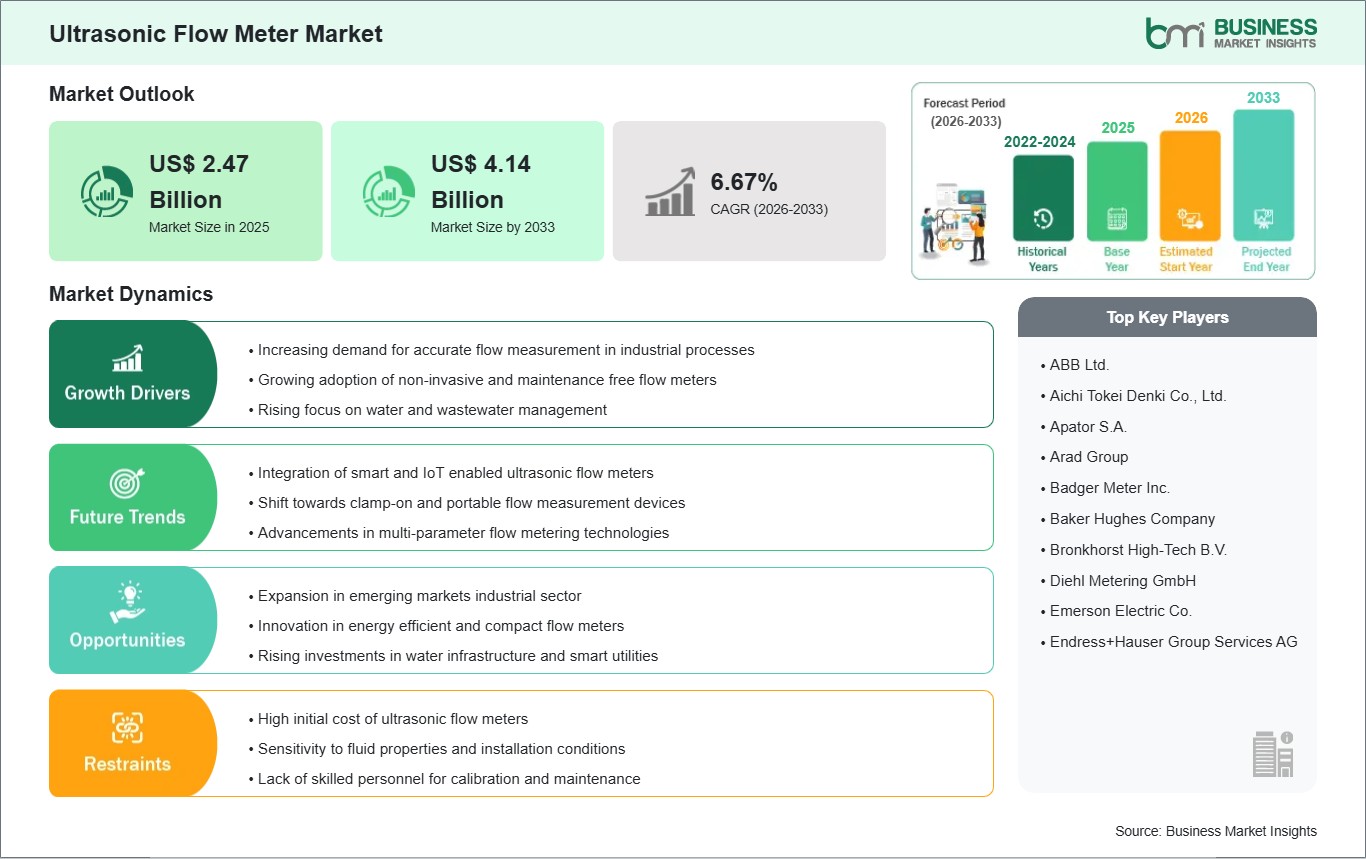
According to Business Market
Insights, the Ultrasonic
Flow Meter Market is anticipated to grow at a CAGR of 6.67%
throughout the forecast period. Increasing demand for smart industrial
automation, expanding decarbonization initiatives, and continuous innovation in
non-intrusive flow measurement technologies are expected to propel the market
from US$ 2.47 billion in 2025 to US$ 4.14 billion by 2033.
Ultrasonic flow meters use
high-frequency acoustic waves to measure the volumetric flow rate of liquids
and gases. They determine flow either by measuring the transit-time difference
of signals traveling with and against the flow or by detecting the frequency
shift caused by the Doppler effect. With no moving parts, these meters provide
highly accurate, non-intrusive measurement, eliminate pressure drops, reduce
long-term maintenance, and perform reliably in corrosive or abrasive
environments. They are essential for process control, custody transfer, leak
detection, and smart water management.
Market Overview The
market is segmented by implementation type, measurement technology, and
end-user industry.
- By
Implementation Type: Clamp-On is gaining substantial share due to its
non-intrusive installation that does not interrupt process flow. Other
segments include Inline and Other Implementations.
- By
Measurement Technology: Transit-Time remains the most widely adopted
for its superior accuracy in clean liquids and gases. Other segments
include Doppler and Hybrid.
- By
End-User Industry: Oil and Gas dominates the market, driven by demand
for precise custody transfer and pipeline monitoring. Other segments
include Power Generation, Water and Wastewater, and Other End-Users.
Get PDF: https://www.businessmarketinsights.com/sample/BMIPUB00034567
Key Growth Drivers and
Opportunities
- Accelerated
Transition to Smart Industrial Automation and Industry 4.0 The
shift toward smart factories and digitalized industrial ecosystems
requires high-fidelity, real-time flow data. Ultrasonic meters deliver
instantaneous digital outputs and advanced signal processing, supporting
automated control systems. Clamp-on technology enables modernization
without costly downtime from cutting pipes.
- Emergence
of the Hydrogen Economy and Decarbonization Infrastructure Hydrogen’s
low density and high flow velocities challenge traditional meters.
Ultrasonic meters offer wide turndown ratios and unobstructed flow paths
with minimal pressure drop, making them ideal for hydrogen production,
distribution, blending, and carbon capture systems.
- Modernization
of Water and Wastewater Infrastructure Municipalities are
replacing aging systems with intelligent ultrasonic networks for leak
detection, non-revenue water reduction, and precise consumption monitoring
without frequent manual intervention.
- Growth
in Emerging Markets and Infrastructure Projects Rapid
urbanization, smart city initiatives, desalination plants, and industrial
expansion in developing regions are increasing demand for reliable,
low-maintenance flow measurement solutions.
Regional Insights North
America is supported by modernization of municipal water systems and shale gas
exploration requiring high-precision measurement. Europe leads in
hydrogen-ready ultrasonic meters and green energy grid integration. Asia
Pacific is a major growth hub driven by high-volume manufacturing,
urbanization, and government smart city projects. The Middle East & Africa
benefits from desalination investments and oil & gas midstream
modernization, while South & Central America sees rising adoption in mining
and food processing through non-intrusive clamp-on technology.
Competitive Landscape The
market is competitive, with global instrumentation and process automation
companies focusing on product innovation, digital connectivity, and specialized
solutions for hydrogen and smart applications. Key players operating in the
Ultrasonic Flow Meter market include:
- ABB
Ltd.
- Aichi
Tokei Denki Co., Ltd.
- Apator
SA
- Arad
Group
- Badger
Meter Inc.
- Baker
Hughes Company
- Bronkhorst
High-Tech BV
- Diehl
Metering GmbH
- Emerson
Electric Co.
- Endress+Hauser
Group Services AG
These companies are strengthening
their positions through advanced multi-path systems, AI-driven diagnostics,
remote verification capabilities, and expansion into energy-transition
applications.
Challenges
- High
initial capital expenditure for multi-path high-precision systems.
- Technical
complexity of signal processing in fluids with high aeration or suspended
solids.
- Specialized
expertise required for installation and calibration of inline variants,
which can deter smaller operators.
Future Outlook
- Continued
integration of AI-driven self-diagnostics and IIoT connectivity for smart
factories.
- Strong
demand growth from hydrogen infrastructure, water management, and oil
& gas custody transfer.
- Expansion
of clamp-on solutions that enable non-disruptive upgrades.
- Development
of specialized “hydrogen-ready” ultrasonic sensors.
- Market
growth supported by infrastructure modernization and the global push for
precise, auditable flow data to meet environmental and regulatory
requirements.
Frequently Asked Questions
(FAQs) What drives the Ultrasonic Flow Meter Market?
The accelerated shift to Industry
4.0 and smart automation, demand for accurate non-intrusive measurement,
expansion of hydrogen and decarbonization infrastructure, and the need for
low-maintenance solutions in water, oil & gas, and power sectors are the
primary market drivers.
Which implementation type is
gaining significant share in the Ultrasonic Flow Meter Market?
The Clamp-On segment is gaining
substantial share due to its non-intrusive nature, allowing installation
without interrupting process flow or requiring pipe cutting.
Which end-user industry holds a
dominant position in the Ultrasonic Flow Meter Market?
The Oil and Gas segment continues
to be a dominant contributor, utilizing high-path-count ultrasonic meters for
precise custody transfer and pipeline leak detection.
More Trending Reports by
Business Market Insights:
Photolithography Equipment Market
Plate and Frame Heat Exchanger Market
About Us:
Business Market Insights is a
market research platform that provides subscription service for industry and
company reports. Our research team has extensive professional expertise in
domains such as Electronics & Semiconductor; Aerospace & Defense;
Automotive & Transportation; Energy & Power; Healthcare; Manufacturing
& Construction; Food & Beverages; Chemicals & Materials; and
Technology, Media, & Telecommunications.
Contact us: If you
have any questions about this report or would like further information, please
contact us:
Contact person: Ankit
Mathur
Email: sales@businessmarketinsights.com
Phone: +16467917070


Comments
Post a Comment